

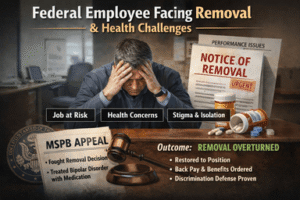
When you’re a federal employee facing a removal, the stress can be overwhelming—especially when health issues are involved. Many people describe feeling isolated, worried about their reputation, and afraid that one difficult period will define their entire career.
These cases can also carry a unique kind of pressure: the fear that speaking up, requesting support, or even explaining what’s happening will be misunderstood. The stakes are real—pay, benefits, professional standing, and a sense of stability.
Sometimes you know the medication works. Sometimes you know you can do the job. And sometimes you worry that no one will look past the diagnosis to see the person who’s been showing up and doing the work.
In a June 21, 1994 decision, the Merit Systems Protection Board (MSPB) reversed an Army removal of a GS-9 Alcohol/Drug Abuse Prevention and Control Counselor. The agency removed the employee for inability to perform, citing behavior the agency attributed to bipolar disorder. The MSPB ultimately found the record supported that the employee could do the job with prescribed medication and that the employee proved an affirmative defense of handicap discrimination. Southworth PC did not represent any party in this matter.
Case Snapshot
Forum: Merit Systems Protection Board (MSPB)
Decision date: June 21, 1994
Agency: Department of the Army
Position: Alcohol/Drug Abuse Prevention and Control Counselor, GS-9
Action challenged: Removal for inability to perform
Medical condition at issue: Bipolar disorder (treated with lithium carbonate)
Defenses raised: Handicap discrimination; race discrimination
Outcome: Removal not sustained; handicap discrimination defense established; race discrimination not established
Relief ordered: Cancellation of removal, restoration effective June 13, 1992, plus back pay, interest, and benefits (as described in the Order)
What Happened
According to the MSPB’s decision, the Army removed the employee from a counselor position after describing several on-the-job incidents that the agency believed showed the employee could not perform the job due to bipolar disorder.
The employee responded that the incidents occurred when he was not taking the medication prescribed for the condition—lithium carbonate—and that he had resumed taking the medication. The employee appealed the removal to the MSPB and raised affirmative defenses of handicap discrimination and race discrimination.
After a hearing, an administrative judge reversed the removal. The agency then petitioned for review by the MSPB.
What the MSPB Decided—and Why
The MSPB granted the agency’s petition for review, but after reviewing the record, it affirmed the administrative judge’s decision and held the removal was not sustained.
A key point in the case was that the parties did not dispute:
- the employee had bipolar disorder,
- lithium treatment was required, and
- lithium treatment would enable the employee to perform the job.
So the central question became whether the employee would continue taking lithium regularly if returned to duty.
The record included medical testimony suggesting that some individuals who stop taking lithium may do so again. But the record also included testimony indicating compliance can increase when an employee confronts a significant life change (such as the risk of job loss).
The MSPB found persuasive a statement from the employee’s treating physician indicating the employee was well, stable, and taking lithium regularly during an eight-month period of care, including time before the removal. The Board emphasized that a physician’s opinion can carry more weight when it reflects treatment over a substantial period.
The MSPB acknowledged the agency’s concern about risk in returning the employee to a counseling role. But it concluded the record did not justify using that risk—on these facts—to permanently foreclose the employee’s continued employment or deny the protections against handicap discrimination referenced in the decision.
Why This Matters for Federal Employees
A removal based on “inability to perform” can feel like a career-ending label—especially when it intersects with mental health. This decision highlights a point many federal employees wish they heard earlier:
If a medical condition is treatable—and the record shows the employee can perform with treatment—the outcome may turn on evidence and credibility, not assumptions.
It also underscores something practical: when an agency bases a decision on perceived future risk, the MSPB may scrutinize whether that concern is grounded in the record—particularly when the condition is controlled and the employee can do the job.
In the real world, people often worry that disclosing a condition (or even explaining it) will trigger stigma, resentment, or career damage. That’s why documenting what’s happening and getting organized early can matter. Federal employment lawyers often help employees translate a chaotic situation into a clear record—timelines, medical documentation at the appropriate level, and job-focused evidence that shows what the employee can (and cannot) do.
Key Takeaways
Separate the diagnosis from the real workplace question: can the employee perform the job’s duties with effective treatment?
Document treatment compliance in a way that is factual, job-relevant, and appropriately private. Collect medical support that reflects meaningful treatment over time when available.
Focus evidence on job duties and performance, not speculation or labels. Challenge generalized “risk” arguments with record-based facts when the condition is controlled.
Understand that disability/handicap discrimination defenses may apply when an adverse action is tied to a covered condition. Track the procedural posture carefully—AJ rulings, petitions for review, and final orders can shape options.
Practical Next Steps
If you’re facing discipline, proposed removal, or an MSPB appeal involving health-related issues, here are practical steps that are often helpful:
- Preserve evidence. Save emails, proposals, decision letters, performance documents, and any written instructions.
- Build a timeline. Write a dated, factual timeline of key events (who, what, when, where).
- Identify witnesses. List coworkers who observed events firsthand and what they can truthfully confirm.
- Keep communications professional. Assume written communications may be reviewed later; stay calm and factual.
- Be thoughtful about medical privacy. Share only what you need to share; keep the focus on functional limitations and job duties.
- Confirm deadlines early. Deadlines can be short. In this decision’s notice, certain review options referenced 30 calendar days based on receipt—your situation may differ, so confirm the rules that apply to your forum and claims.
- Consider counsel. Talking with attorneys for federal employees can help you evaluate forums, evidence, and strategy without guessing.
If you want plain-language background reading, these resources can help you orient: Merit Systems Protection Board (MSPB) overview, MSPB wrongful termination, EEOC overview, EEOC retaliation, FMLA and disability discrimination, Office of Special Counsel for whistleblower protection, MSPB official site, EEOC Rehabilitation Act (Sections 501 and 505), EEOC Title VII statute page, and eCFR 29 CFR Part 1614.
A Word From Southworth PC Leadership
“When a federal employee’s health intersects with job performance, the record matters. A clear, respectful, well-documented story can make a hard situation easier to evaluate.” — Shaun Southworth, Co-Owner of Southworth PC
How Federal Employment Attorneys Can Help
Federal employment attorneys can support federal employees in a range of career-impacting situations—without making the process more stressful than it already is. In general, counsel may help by clarifying the forum (some matters go through the MSPB; some go through the EEO process; some are “mixed” with both), organizing evidence (turning scattered documents and memories into a coherent, dated record), framing the issues (explaining what an agency must prove in an “inability to perform” removal and how affirmative defenses may be evaluated), preparing for hearings and review (helping with witness prep, exhibits, and procedural steps), and coordinating overlapping issues.
For example, a federal employee EEO attorney may help evaluate how discrimination claims fit alongside other claims, depending on the forum and posture.
In removal matters, MSPB appeals can move quickly and involve detailed procedural rules. Having support early can reduce missed issues and help you make informed decisions. Working with federal employee attorneys can be especially valuable when the situation involves multiple moving parts: medical documentation, credibility disputes, and potential parallel processes. And where the issue involves alleged retaliation for protected activity, a federal employee retaliation attorney can help you frame events in a way that is clear, professional, and tied to the timeline.
Talk With Our Team
If you’re dealing with a proposed removal, an MSPB appeal, or disability-related workplace concerns, talking with Federal Employee Attorneys may help you understand your options and next steps—without adding pressure or making promises about outcomes.
Southworth PC is serving federal employees nationwide and abroad. Use the contact form below to reach Southworth PC.
FAQ
What does the MSPB do in federal employee removal cases?
The MSPB reviews certain federal employment actions, including removals, to determine whether the agency met its burden and whether defenses apply. The process can involve evidence, testimony, and legal standards that vary by claim type and posture.
When should I speak with MSPB Attorneys about a removal?
If you receive a proposed removal or decision letter, it’s usually wise to learn what deadlines and forum rules apply as soon as possible. MSPB Attorneys can help you understand the process, what evidence matters, and how to present your story in a clear, job-focused way.
How does disability discrimination show up in MSPB cases?
Some cases involve allegations that an adverse action is tied to a medical condition. The terminology in older decisions may use “handicap,” while modern discussions often use “disability,” but the central issue often involves job duties, treatment, and whether protections apply under applicable laws.
What is the role of a federal employee retaliation attorney?
A federal employee retaliation attorney typically helps evaluate whether protected activity (like EEO participation or other protected disclosures) was followed by adverse actions and whether there’s evidence of reprisal. Even when retaliation isn’t the main issue, documenting timelines and decision-makers can be important.
Can Federal Employee Lawyers help if my case involves both MSPB and EEO issues?
Yes—Federal Employee Lawyers often help clients understand how discrimination allegations and personnel actions may intersect, especially in “mixed” situations. The right approach depends on the forum, the posture of the case, and the facts—so getting clarity early can be valuable.
Disclaimer
This post is for informational purposes only and is not legal advice. Reading this post does not create an attorney-client relationship. Outcomes depend on the specific facts, evidence, and procedural posture of each matter. Southworth PC did not represent any party in this matter. Southworth PC handles matters for federal employees.